Enquiry
 Call
Call Whatsapp
 Contact us
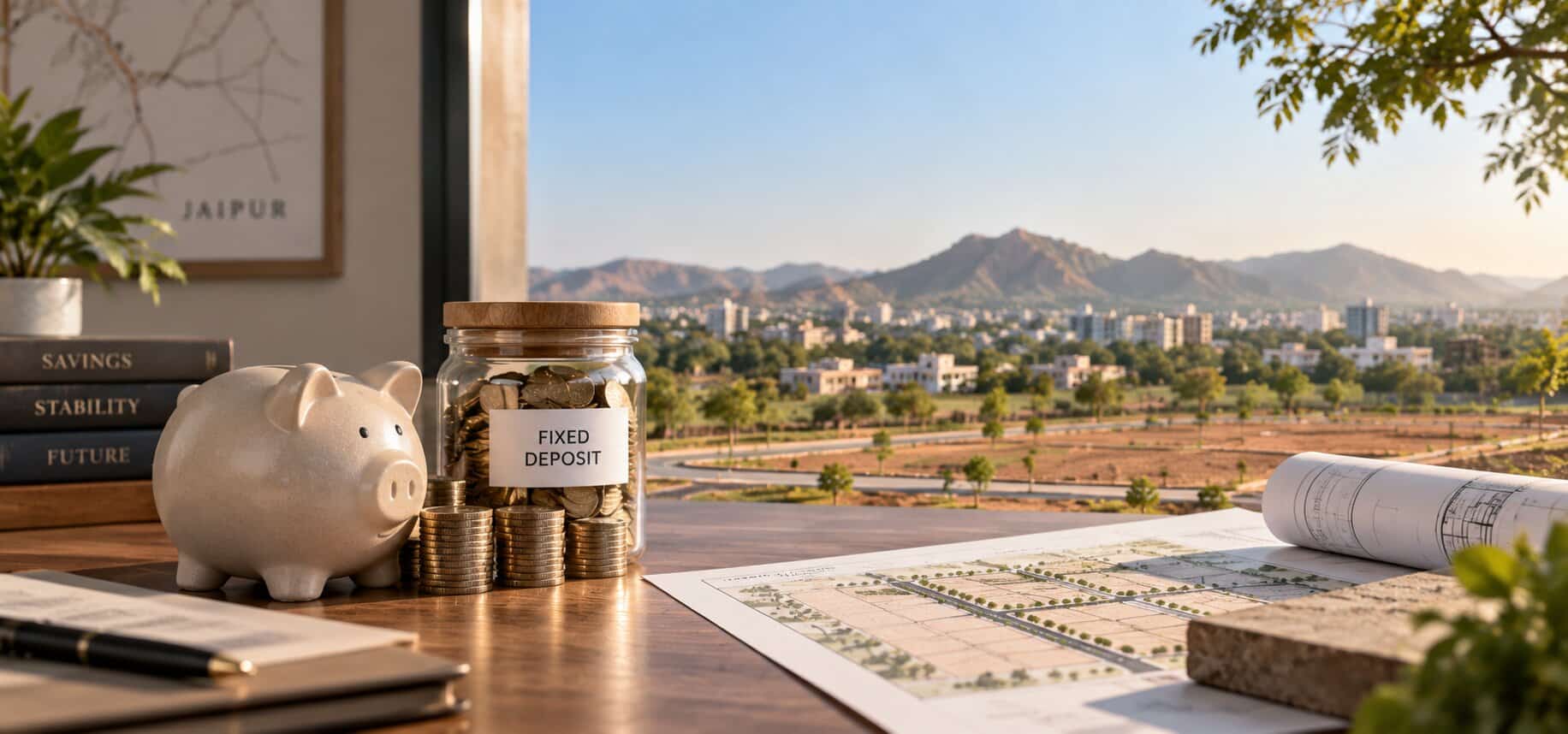
For years, a fixed deposit was the first stop for anyone in Jaipur who wanted to protect their savings. Parents opened FDs for their children’s education. Retirees relied on the interest for monthly expenses. That instinct made sense when land felt out of reach or too complicated to manage.
Investor behaviour is changing, though. More people are weighing a fixed deposit vs real estate investment decision before they park a single rupee, and a growing number are choosing land instead of another FD. Here’s what’s driving that shift, and what it actually means for your money.
FD vs Real Estate: What Makes a Fixed Deposit Feel Safe
A fixed deposit works exactly the way it sounds. You hand your money to a bank for a fixed period, and the bank pays a fixed rate of interest in return. Right now, most top banks offer between 6.5% and 7.4% per year on regular deposits, according to Policybazaar’s FD rate tracker. That rate barely moves once you lock it in, which is exactly why so many investors trust it.
The catch shows up at tax time. Every year, the tax department adds your FD interest to your income and taxes it at your slab rate, whether you touch the money or not. So while the interest looks steady on paper, a chunk of it disappears before it ever gets the chance to compound. For someone in a higher tax bracket, that steady 7% can quietly turn into 5% or less after tax.
None of this makes an FD the wrong choice in the fd vs real estate comparison. It just means the safety comes with a ceiling, and that ceiling rarely moves no matter how long you wait.
What Land Actually Offers That an FD Can’t
Land works on a completely different logic. Once you own a plot, you hold a tangible asset that you can see, walk on, and build on instead of a number sitting on a bank statement. That difference matters more than it sounds.
The numbers back this up too. Ajmer Road, where much of Jaipur’s newer development is happening, saw residential rates grow to around ₹18,000 per square metre with 26.3% year-on-year growth, according to a 2026 Jaipur residential market outlook report. That kind of growth compounds very differently from a fixed interest rate. We’ve tracked this corridor’s rise in more detail in our piece on Ajmer Road’s real estate investment outlook.
Land also gives you options an FD never will. You can build on it, lease it, or simply hold it as a long-term family asset, which an FD simply can’t offer. If gold has been part of your safety net too, we’ve weighed it against real estate separately.
Comparing the Numbers: Fixed Deposit vs Real Estate Investment
Set the two side by side and the differences become clear. An FD gives you a fixed, predictable return between roughly 6.5% and 7.4% a year, and taxes take a slice of it annually no matter when you actually use the money. Land, by contrast, pays you nothing while you hold it, but its value can grow well beyond that rate in the right location, and you only pay tax when you sell.
That tax timing matters more than most investors realise. Under current rules, the government taxes long-term capital gains on property you buy after July 2024 at 12.5% without indexation, once you’ve held it for over two years. Compare that to an FD, where the taxman takes a cut every single year. The land investment vs fixed deposit question then becomes a matter of timing and patience rather than a toss-up.
Liquidity is the one place FDs still win outright. You can break a fixed deposit in a day, while selling land takes time, paperwork, and the right buyer. So the real question isn’t which asset performs better on paper. It’s which trade-off, speed or growth, fits your goals. That’s the heart of the fixed deposit vs real estate investment decision: predictable but capped, against patient but far more rewarding.
Before You Move From FD to Land, Do This
Moving from a fixed deposit to land isn’t something to rush into just because the growth numbers look attractive. A few checks upfront save you from problems later.
- Confirm the plot has JDA approval and a clean title before you pay anything.
- Choose a corridor with proven growth, not just promised growth, the way Ajmer Road has shown recently.
- Hire an independent valuer to confirm what the plot is actually worth, the way our guide on property valuation explains.
- Keep some money in liquid instruments like an FD for emergencies, even after you invest in land.
None of these steps take long, but skipping any one of them is how good investments turn into stressful ones.
Why Investors Are Choosing Ajmer Road and Vaishali Nagar
Jaipur’s growth corridors aren’t all rising at the same pace, and that’s exactly why location decides most of the outcome in this debate. Ajmer Road and Vaishali Nagar have both seen consistent development, which is part of why land here behaves differently from a stagnant pocket of the city.
Yaduraj Realty has been building in these corridors for years, with residential plots that suit exactly this kind of long-term investor. If you’re exploring options, our plots in Jaipur page lays out what’s currently available, including ongoing projects like Yaduraj Ojas on Ajmer Road and Yaduraj Prime in Vaishali Nagar.
None of this means an FD has no place in your portfolio. It just means land, in the right corridor, tends to reward patience in a way a fixed deposit never can.
The fixed deposit vs real estate investment question doesn’t really have one universal answer. FDs still make sense for short-term goals and emergency funds. Land makes more sense once you’re thinking in years rather than months, and once you’re ready to hold something you can actually see and build on.
For many investors in Jaipur, the shift toward tangible assets isn’t about abandoning FDs altogether. It’s about giving land the role a fixed deposit simply can’t fill.