Enquiry
 Call
Call Whatsapp
 Contact us
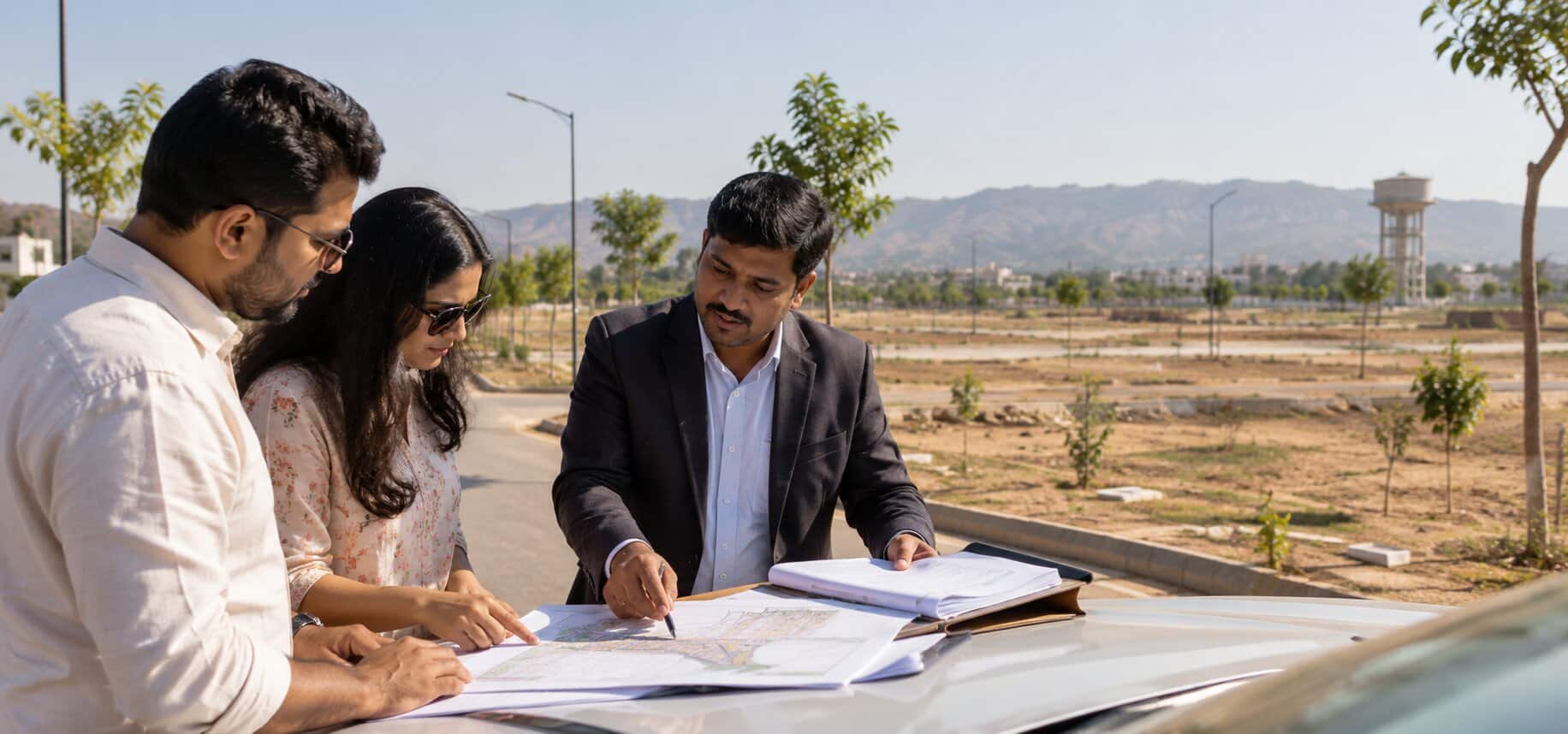
First-time plot buyers in Jaipur often move faster than the process allows. A location looks right, the price feels reasonable, and the excitement of owning land takes over before anyone checks every document. That’s usually how common mistakes first-time plot buyers make in Jaipur begin, not from bad intentions but from moving too quickly through the process.
Jaipur’s growth corridors, from Ajmer Road to Vaishali Nagar, have pulled in more first-time investors over the last few years than ever before. That growth brings opportunity, but it also brings sellers and agents who know how to make a plot look ready when it isn’t. The mistakes below are the ones that trip up first-time buyers most often, and each one has a straightforward way to avoid it before you sign anything.
Mistake 1: Not Verifying JDA Approval
A JDA-approved layout means the Jaipur Development Authority has reviewed and cleared the plot’s layout plan, road widths, and civic amenities. Skip this check, and you could end up with a plot that a bank refuses to finance or a future buyer refuses to purchase, since most lenders and serious buyers ask for the same proof you should have asked for first.
First-time buyers often assume that because a colony looks developed, with roads laid and plots marked out, the approval must already exist. That assumption causes real damage. An unapproved layout can face demolition orders or lose access to basic civic services down the line, and neither problem shows up during a quick site visit.
Ask the seller for the JDA approval number and cross-check it yourself rather than accepting a verbal confirmation. If you’re unclear on what JDA approval actually covers, our guide on what a JDA plot means breaks down exactly what to look for.
Mistake 2: Assuming RERA Registration and JDA Approval Are the Same Check
RERA registration and JDA approval answer two different questions, and treating them as interchangeable is one of the most common mistakes first-time plot buyers make in Jaipur. RERA registration tells you whether the promoter has entered the official regulatory system and disclosed the required project details. JDA approval tells you whether the local authority has cleared the actual layout and plan.
A project can carry one without the other. A buyer who checks only the RERA number, and skips the JDA layout approval, still has a real gap, and the reverse is just as true. Both checks protect against different risks, so neither one can substitute for the other.
This confusion sits at the centre of plot buying mistakes to avoid in Jaipur specifically, since different authorities run the two systems for different purposes. Our comparison of JDA and non-JDA plots walks through exactly where each check applies and why you need both.
Mistake 3: Not Confirming the Land’s NA Conversion
Land in Rajasthan defaults to an agricultural classification unless someone has formally converted it. Buying agricultural land for a residential plot without that conversion in place is a mistake that surfaces months or years later, usually right when you try to build or resell.
The conversion, commonly called an NA order, changes the land’s legal use from agricultural to non-agricultural or residential. Without it, construction can face restrictions, and some transactions can even face legal challenges after the fact. First-time buyers rarely ask about this because the plot already looks like part of a developed colony, but appearance and legal status are two separate things.
Before you commit, ask specifically for the NA order or a copy of the conversion certificate, not just the sale deed. A seller who hesitates on this document is telling you something important.
Mistake 4: Underestimating the Real Cost of Buying
First-time buyers often budget for the plot price and stop there. That’s a mistake, since Rajasthan adds stamp duty, a registration fee, and a labour cess on top of whatever price you agree with the seller.
Here’s how it adds up. Stamp duty runs 6% of the property’s value for male buyers and joint ownership, or 5% for sole female ownership, calculated on whichever is higher between the market value and the government’s DLC rate. On top of that, a 20% labour cess applies to the stamp duty amount itself, and a flat 1% registration fee applies to every transaction. Add these together, and your total registration cost lands well past 7% of the plot’s value, before you’ve spent a rupee on the plot itself.
For a plot valued at 50 lakh rupees, that difference alone can run into several lakhs. Budget for the full amount from the start, not just the headline price, so the final paperwork doesn’t derail your financing.
Mistake 5: Trusting the Seller’s Word Instead of Checking Title and Encumbrance
A confident seller and a clean plot are not the same thing. Many first-time buyers accept a seller’s assurance about clear ownership without asking for the title documents or an encumbrance certificate, and that trust can cost them the entire investment if a dispute surfaces later.
An encumbrance certificate confirms the property carries no pending loans, litigation, or unresolved claims. Title documents confirm the seller actually has the legal right to sell. Both take time to verify properly, but that time is far cheaper than a legal dispute after you’ve paid.
Insist on seeing these documents yourself, or have a lawyer review them, rather than relying on what the seller or the broker tells you. If something in the paperwork looks unclear, treat that as a reason to pause, not a detail to skip.
Mistake 6: Getting Pulled In by an Unusually Low Price
A plot priced well below everything nearby usually has a reason, and that reason is rarely good news for the buyer. This is one of the plot buying tips for beginners that first-time investors ignore the most, because a lower price feels like an opportunity rather than a warning sign.
Missing approvals, disputed ownership, or a location with real access problems are the usual explanations behind a price that looks too good to be true. Sellers count on excitement moving faster than due diligence, especially with first-time buyers who haven’t compared enough listings to recognise when a number looks off.
Before you get curious about a low price, ask why it’s low. If the seller can’t give you a clear, verifiable answer, treat the price itself as the red flag.
Mistake 7: Skipping an Independent Valuation
The seller’s number and the plot’s actual worth are not always the same figure. Buyers who skip an independent valuation rely entirely on the seller’s pricing logic, which naturally favours the seller, not the buyer.
An independent valuation looks at recent transactions in the area, the plot’s exact location within the corridor, and its legal status together, rather than taking any single number at face value. That process protects you from paying inflated rates simply because a plot sits inside a hyped corridor.
This step matters even more for first-time buyers who don’t yet have a feel for what fair pricing looks like in a specific pocket of Jaipur. Our guide on property valuation explains exactly what a proper valuation should account for before you finalise anything.
How Yaduraj Realty Approaches These Checks
Every mistake above comes down to the same root cause: buyers moving on a plot before they fully verify its documentation. Yaduraj Realty structures its own projects around avoiding exactly that gap, with JDA-approved layouts, transparent pricing, and documentation buyers can review before they commit to anything.
That approach comes from years of building across Ajmer Road and Vaishali Nagar, where buyers ask sharper questions than they used to and expect clear answers in return. If you’re exploring options in these corridors, our plots in Jaipur page lays out what’s currently available, along with the approval status for each project.
None of this replaces your own due diligence. It just means the starting point is already cleaner than plots where these checks haven’t happened yet.
Most of the mistakes first-time plot buyers make in Jaipur don’t come from bad luck. They come from moving quickly through a process that rewards patience, and from trusting reassurance over documents that anyone can actually verify.
None of these checks take more than a few days, and every one of them is far cheaper than fixing a problem after you’ve paid. Slow down at the stages that matter, ask for the paperwork every time, and owning your first plot in Jaipur stays something to look forward to, not a legal headache.